Starting an online business in Nepal has never been more promising or more competitive. From local fashion boutiques in Kathmandu to handicraft exporters in Pokhara, businesses across the country are moving online to meet increasing customer demand.
However, one critical decision can determine your store's long-term success: choosing the right e-commerce platform.
Picking the wrong system can lead to slow site speeds, payment failures during checkout, difficult inventory management, and high maintenance bills. In this comprehensive guide, we will break down key factors to consider when choosing an e-commerce platform in Nepal, compare top platform models, and help you select the ideal solution for your budget and goals.
Key Factors to Consider When Choosing an E-Commerce Platform in Nepal
Building an online store in Nepal requires addressing unique local business challenges. Here are five essential criteria to evaluate before making your decision:
1. Integration with Local Digital Wallets & Payment Gateways
In Nepal, credit card usage remains relatively low compared to mobile wallets. Your platform must seamlessly connect with:
eSewa
Khalti
Fonepay / QR Payments
Cash on Delivery (COD) tracking
Ensure your platform supports local payment plugins and APIs without requiring expensive custom development every time a gateway updates.
2. Logistics & Courier Connectivity
Fulfilling orders efficiently requires reliable logistics integrations. Look for platforms that support automatic shipping rate calculations, order tracking, and API connectivity with major local delivery services like Pathao Courier, Nepal Can Move (NCM), or Upaya Logistics.
3. Total Cost of Ownership (TCO)
E-commerce costs in Nepal generally fall into three tiers:
| Platform Tier | Estimated Initial Cost (NPR) | Typical Best Use Case |
| Basic / Entry-Level | NPR 30,000 – 80,000 | Small shops with 10–50 products |
| Mid-Range E-Commerce | NPR 80,000 – 300,000 | Growing brands with 100–500 products |
| Enterprise / Custom | NPR 300,000 – 1,500,000+ | High-traffic platforms, multi-vendor marketplaces |
Consider hosting, security (SSL), domain renewals (.com vs. free .com.np), and ongoing developer maintenance fees alongside initial setup costs.
4. Mobile-First Experience
Most digital shoppers in Nepal browse and buy using smartphones. Your platform must offer fast mobile loading times, responsive mobile checkout flows, and clean interfaces that perform smoothly even on 3G/4G network connections.
5. Local Legal & Compliance Readiness
Under local e-commerce standards, stores need dedicated space to display:
Company Registration details & PAN/VAT numbers
Transparent return, refund, and shipping policies
Automated VAT invoice generation for tax compliance
Comparing Your Platform Options
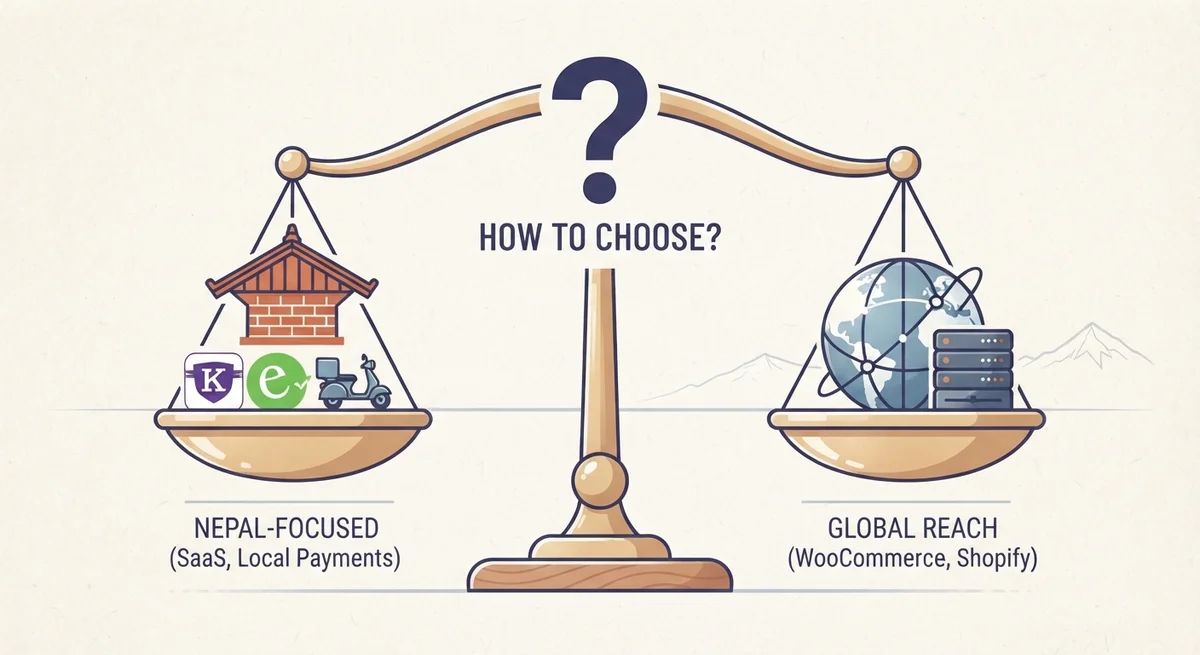
Depending on your technical expertise, business size, and budget, you have four main avenues to build your store:
                          ┌────────────────────────┐
                          │ E-Commerce Approaches  │
                          └───────────┬────────────┘
                                      │
     ┌──────────────────┬─────────────┴────────────┬──────────────────┐
     ▼                  ▼                          ▼                  ▼
┌─────────┐      ┌──────────────┐          ┌──────────────┐   ┌────────────────┐
│ SaaS    │      │ Open-Source  │          │ Global SaaS  │   │ Custom-Built   │
│ Nepal   │      │ (WooCommerce)│          │ (Shopify)    │   │ (Laravel/Node) │
└─────────┘      └──────────────┘          └──────────────┘   └────────────────┘
1. Hosted Local SaaS Platforms
Best For: Small to mid-sized businesses wanting a turnkey, hands-off setup.
Pros: Pre-built native integrations for eSewa/Khalti, no manual server maintenance, and low setup friction.
Cons: Monthly subscription model and fixed layout templates.
2. Self-Hosted WooCommerce (WordPress)
Best For: Businesses requiring flexible content publishing and total source-code ownership.
Pros: Highly customizable with thousands of plugins, no monthly software platform fees.
Cons: Requires active hosting management, security updates, and local payment gateway updates from developers.
3. Global SaaS (e.g., Shopify)
Best For: International merchants or exporters targeting global customers.
Pros: Extremely reliable infrastructure, top-tier app ecosystem, and sleek admin controls.
Cons: Platform fees paid in foreign currency (USD), transaction add-ons, and limited native support for Nepali payment wallets.
4. Custom Frameworks (Laravel, Node.js, React)
Best For: Large enterprises, custom workflows, or multi-vendor marketplace models.
Pros: Unlimited scalability, bespoke UI/UX designs, and unique feature development.
Cons: High upfront cost and long development lead times.
Final Decision Matrix: Which Platform Is Right for You?
Choose a Local SaaS / Managed Solution if you want to launch quickly without technical hassle or heavy upfront coding fees.
Choose WooCommerce if you have a developer on call and want to build content-driven marketing alongside product lists.
Choose Custom Development if you need unique features, high system integration, or plan to build a large multi-vendor marketplace.
Ready to Launch or Upgrade Your Online Store?
At Run-ecommerce.com, we simplify online selling for businesses across Nepal. Whether you need custom store development, smooth eSewa/Khalti payment integration, or performance optimization, our team delivers high-converting, scalable e-commerce solutions.
👉 Contact Run-Ecommerce Today for a Free Store Consultation
Frequently Asked Questions (FAQs)
Q1: How much does it cost to integrate eSewa or Khalti on an e-commerce store in Nepal?
Integration costs typically range between NPR 5,000 to NPR 15,000 per gateway, covering API installation, testing environments, and live deployment.
Q2: Is a .com or .com.np domain better for an online store in Nepal?
A .com.np domain is completely free for officially registered Nepali entities or citizens. However, a .com domain (approx. NPR 1,500–2,500/year) is often preferred for international brand recognition and consumer trust.
Q3: Can I run an e-commerce website in Nepal without a registered business?
While basic social media selling happens informally, integrating local payment gateways and complying with local regulatory guidelines requires a registered business entity with a PAN or VAT registration.